
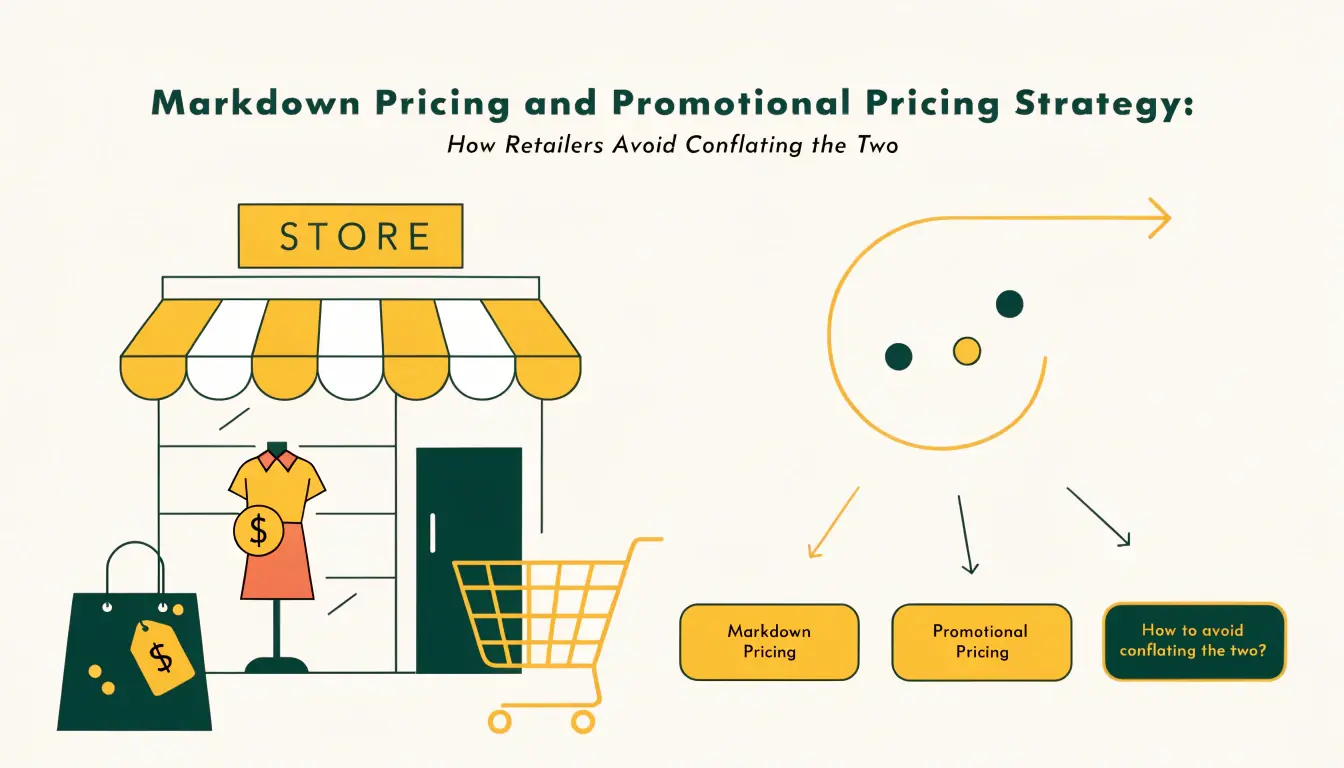
- Markdown pricing and promotional pricing strategy serve different commercial purposes and require different logic, data inputs, and success metrics.
- Conflating the two leads to margin erosion: promotional discounts applied to products that need clearance logic, and clearance depth applied to products that need demand stimulation.
- Markdown pricing is inventory-driven. The objective is recovering value from stock that will cost more to hold than to sell at a reduced price.
- Promotional pricing strategy is demand-driven. The objective is stimulating purchase behavior on products that have margin to protect and volume to gain.
- Enterprise retailers who separate the two operationally make better decisions in both areas.
Discounting covers a lot of ground in retail. A 20% reduction on a seasonal line approaching end-of-season and a 20% promotion on a high-velocity category leader look identical on a price tag. Operationally, commercially, and strategically, they are completely different decisions.
Markdown pricing is triggered by inventory reality. A product needs to move before its commercial window closes. The pricing question is how deep a discount clears stock efficiently without leaving recoverable margin on the table.
A promotional pricing strategy is triggered by demand opportunity. A retailer wants to stimulate purchase behavior, drive category traffic, or respond to a competitive move. The pricing question is how much discount generates the volume and basket uplift that justifies the margin investment.
Applying markdown logic to a promotional decision, or promotional logic to a markdown situation, produces predictable commercial damage. Understanding the difference is the starting point for getting both right.
What Markdown Pricing Is Actually Solving
Markdown pricing addresses a specific inventory problem. A product is holding stock that is losing value over time, whether through seasonal obsolescence, supersession by a newer model, or simple overstock relative to remaining demand. The commercial objective is to recover as much value as possible from that inventory before the holding cost or obsolescence cost exceeds the recoverable margin.
The pricing decision in a markdown situation is not about what price will maximize per-unit margin. That window has passed. The decision is about what price will move inventory at a rate that clears stock within the available window while recovering more value than the alternative of holding, writing down, or disposing of the inventory.
Three variables determine the right markdown depth in a retail context:
Remaining inventory volume. How many units need to move, and over what timeframe? A large inventory position with a short window requires a deeper initial markdown than a modest overstock with several weeks remaining.
Current demand trajectory. Is the product still selling at a declining rate, or has demand effectively stopped? A product with residual demand needs less aggressive markdown logic than one where purchase frequency has dropped to near zero.
Carrying cost relative to recovery value. What does it cost to hold one unit for one additional week? When that cost approaches the margin recoverable from a sale at current price, the case for a deeper markdown becomes commercially straightforward.
Markdown campaigns that ignore these variables, applying a uniform discount percentage across all end-of-life stock regardless of inventory position or demand trajectory, consistently under-recover on products with residual demand and over-discount on products where a shallower markdown would have cleared stock equally well.
What a Promotional Pricing Strategy Is Actually Solving
A promotional pricing strategy addresses a demand opportunity rather than an inventory problem. The product has stock available, margin to invest, and a commercial case for stimulating purchase behavior at a given point in the trading calendar.
The objective is not clearance. The objective is volume uplift, basket growth, category traffic, or competitive response, depending on the retailer’s current commercial priorities. Success is measured not just by whether the promotion moved units but by whether the incremental volume and basket impact justified the margin investment.
This distinction matters because promotional pricing carries a cost that markdown pricing does not. A markdown on end-of-life stock is recovering value from inventory that would otherwise be written down. A promotion on a healthy product is investing margin in a demand outcome. That investment needs to generate a return that exceeds the cost of the discount.
Four failure modes are common when promotional pricing strategy is poorly constructed:
Promoting products that would have sold anyway. A product with strong organic demand gets promoted. Volume increases, but the incremental volume above baseline is minimal. The retailer has paid margin to move units they would have sold at full price.
Discount depth that doesn’t change behavior. A 5% promotion on a product where customers require a 15% reduction to switch behavior generates no incremental demand. The margin is spent without a volume return.
Promotional cannibalization. A promotion on a branded product pulls demand away from an own-brand alternative at full margin. The category volume holds but the margin mix deteriorates.
Promotional habituation. A product promoted repeatedly on the same cycle trains customers to wait for the discount. Full-price sell-through drops permanently, and the retailer has created a margin problem that persists beyond the promotional period.
Keeping Markdown and Promotional Logic Separate at Scale
The operational challenge for enterprise retailers is that markdown and promotional decisions happen simultaneously, across hundreds of categories, on overlapping timelines. Without a system that separates the two explicitly, pricing teams default to treating all discounts through the same lens, usually a promotional one, because that’s the more familiar decision type.
Competera’s Pricing Platform separates markdown and promotional pricing at the campaign level. Markdown campaigns are configured with inventory-driven logic, where discount depth and wave timing are calibrated to sell-through targets and remaining stock. Promotional campaigns are configured with demand-driven logic, where discount depth is validated against demand elasticity and basket impact before execution. The two run in parallel without interference, each applying the logic appropriate to its commercial purpose.
For category managers, this means a seasonal clearance decision and a competitor response promotion in the same category get different treatments by default, not because the team remembered to apply different logic, but because the system enforces the separation structurally.
Markdown pricing and promotional pricing strategy are not two versions of the same decision. They serve different objectives, require different data, and produce different outcomes when applied correctly. Retailers who treat them as distinct disciplines, and build systems that enforce that distinction operationally, recover more margin from clearance and generate better returns from promotional investment.